
Deixe um recado
Se você estiver interessado em nossos produtos e quiser saber mais detalhes, deixe uma mensagem aqui e responderemos assim que possível.


Uniboot LC Patch Cord philosophy behind Uniboot is to "trade structure for space, and mechanisms for efficiency."
The product philosophy behind Uniboot is to "leverage structure to gain space, and utilize mechanisms to enhance efficiency." By housing two optical fibers within a single round jacket and enabling tool-free polarity switching, Uniboot addresses two practical pain points encountered at high-density panels: limited finger access and the risk of incorrect polarity configuration. This overview examines the product across four dimensions: structure, application scenarios, operation, and market.
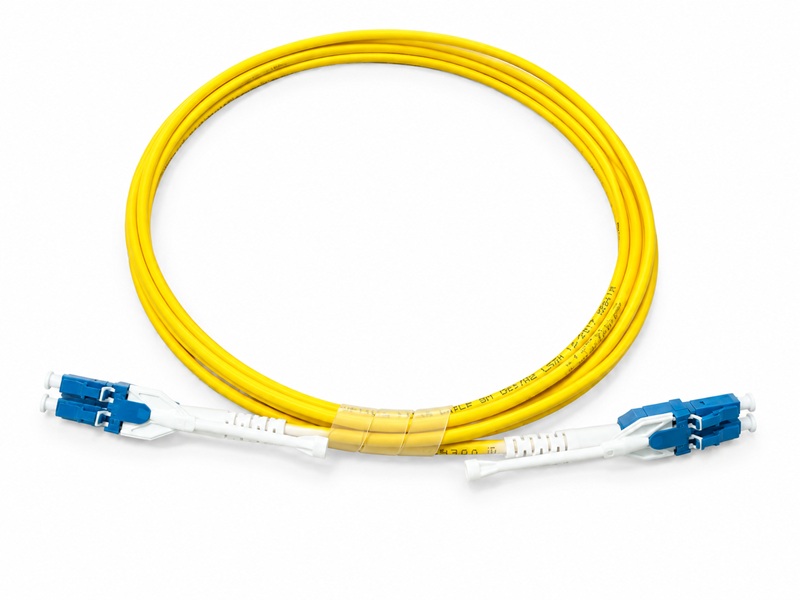
Product Structure: Dual-Fiber Single-Jacket Design, Integrated Boot, and Reversible Mechanism
At its core, the Uniboot is an enhanced LC duplex connector. It houses two optical fibers within a single 2.4 mm or 3.0 mm jacket—a "dual-fiber, single-jacket" configuration. This eliminates the "zip-cord" structure required for traditional duplex patch cords, resulting in a total thickness of approximately 9.2 mm—a reduction in cabling volume of about 50% compared to standard LC duplex patch cords.
In terms of components, a typical Uniboot connector consists of a dust cap, front housing, ceramic ferrule, rear shank, spring, back housing, main body, top and bottom covers, a boot, and a latch or mechanism for polarity switching. It utilizes a standard 1.25 mm zirconia ceramic ferrule, ensuring optical performance consistent with conventional LC connectors: a standard insertion loss of ≤0.3 dB (with low-loss versions achieving ≤0.15 dB), return loss of ≥50 dB (UPC) or ≥60 dB (APC), and an additional insertion loss of <0.3 dB even after 500 mating cycles.
Two key structural innovations distinguish the Uniboot: the integrated boot and the reversible latch. The integrated boot consolidates strain relief for both fibers while serving as a grip point for push-pull operation. The reversible latch allows the connector body to be rotated 180°—without exposing the optical fibers—to facilitate polarity swapping. Some high-density variants feature an integrated pull-tab and key mechanism within the connector boot. This design facilitates the insertion and removal of connectors in ultra-high-density panels while simultaneously providing port-locking and security functions.
Use Cases: Environments Requiring High Density and Polarity Flexibility
High-density data centers are the primary domain for Uniboot cables. In environments such as 1U switch panels—where port spacing is extremely tight—the "zip-cord" design of traditional duplex patch cords can obstruct adjacent ports, hinder access to connector latches, and impede airflow (impacting cooling). Uniboot’s single-jacket, round-cable design reduces cable bulk by half. Combined with a push-pull boot, it allows operators to simply "grab the boot" to disconnect, eliminating the need to fumble for latches in cramped spaces. This requirement becomes even more critical as networks evolve toward 400G/800G, which utilize breakout connections for modules like QSFP-DD and OSFP.
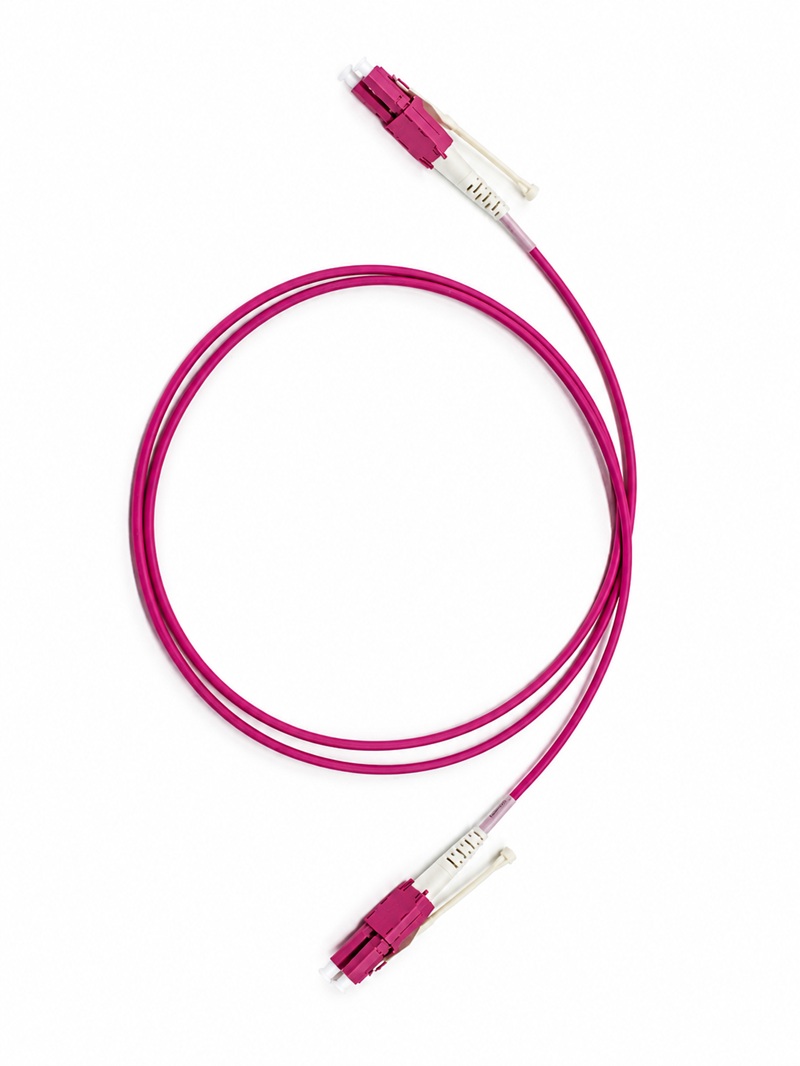
Cabling for AI and GPU clusters represents a significant growth area. The extensive leaf-spine interconnections and server uplinks within GPU clusters demand exceptionally high port density; in this context, Uniboot’s ability to reduce cable congestion within limited rack space directly translates into improved thermal management and operational efficiency.
Scenarios sensitive to polarity management also benefit. Traditional duplex patch cords require separate part numbers for A-B and A-A polarities; if a polarity mismatch is discovered during commissioning, the cable must either be replaced or re-terminated. A single Uniboot part number covers both polarities—which can be swapped on-site—thereby reducing the number of SKUs to stock and minimizing the risk of configuration errors.
Furthermore, some manufacturers have extended the use of Uniboot to outdoor applications, such as FTTA (Fiber-to-the-Antenna), leveraging its "press-and-flip" polarity feature to reduce the need for specialized tools during tower-top operations. However, in environments like LAN, SAN, and FTTH, where the demand for high density and polarity flexibility is less acute, the value proposition of Uniboot’s premium pricing is relatively limited.
How to Use: Insertion/Removal and Polarity Switching Are the Two Core Operations
Insertion and Removal
Uniboot connectors offer tiered insertion/removal methods to accommodate varying density requirements:
• Traditional Manual Press: Used in standard data center environments; the connector is inserted or removed by directly pressing the latch.
• Boot-Pull Operation: The primary method for high-density scenarios. Suncall’s "LC Pull Uniboot" utilizes a reinforced boot—pulling the boot releases the latch. No tools are required, and the connection remains secure when the boot is not being pulled.
• Pull-Tab / Pull-Tab with Key: Designed for ultra-high-density configurations (e.g., 96-fiber or 192-fiber setups). The pull-tab extends the reach, allowing for safe insertion and removal in deep ports that are otherwise inaccessible by hand; the key feature also prevents unauthorized disconnection.
Polarity Switching (Examples Using Two Common Latch Types)
Polarity switching requires no tools, and the optical fibers remain fully enclosed/protected throughout the process.
For the "LC Flat Clip + Push-Pull Boot" design, the steps are: ① Unlock the latch from the rear; ② Rotate the connector housing 180°; ③ Rotate the connector body 180°; ④ Reattach the boot.
For the standard "LC Flat Clip" design, the procedure differs slightly: ① Align the grooves; ② Remove the clip; ③ Rotate the connector body 180°; ④ Reinstall and lock the clip. Some products from Legrand feature an even simpler process: slide the boot back along the cable, rotate the connector 180°, and slide the boot back into its original position. While specific release mechanisms and rotation sequences may vary by manufacturer, the underlying logic remains the same: the physical positions of the two optical fibers are swapped by rotating the connector body.
Market Potential: Niche Segments Outpace General Product Categories—But Mind the Data Scope
Market data for Uniboot connectors can vary significantly depending on the statistical scope used; therefore, such figures should be interpreted with careful attention to how they are defined. Broad Scope (LC Uniboot Connectors): According to QYResearch, global sales are projected to reach approximately $902 million in 2025 and $1.214 billion by 2031, representing a compound annual growth rate (CAGR) of about 5.10%. This scope encompasses "Uniboot" connectors and related integrated dual-fiber variants, reflecting the steady, foundational growth of a mature product category.
A narrower scope—specifically "Push-Pull Uniboot" connectors—exhibits a higher growth rate. According to ResearchIntelo, the global market for LC Push-Pull Uniboot connectors is valued at approximately $1.2 billion in 2024 and is expected to reach $2.8 billion by 2033, reflecting a CAGR of 9.7%. This segment focuses on variants equipped with push-pull mechanisms, which are more directly aligned with high-density data center environments and consequently experience faster growth. While the absolute figures from these two datasets are not directly comparable, they both point to a clear trend: Uniboot variants that offer greater convenience for high-density operations possess stronger growth momentum.
Regionally, North America holds the largest revenue share, driven by the maturity of its hyperscale data centers and cloud computing infrastructure. The Asia-Pacific region is expected to be the fastest-growing market, with a projected CAGR of 12.5% between 2025 and 2033, fueled by data center construction and network upgrades across China, India, and Southeast Asia.
The competitive landscape is fragmented yet characterized by a concentration of leading players. Key participants include CommScope, Corning, SENKO, US Conec, Sumitomo Electric, Molex, Furukawa, Amphenol, Panduit, Suncall, Huber+Suhner, Rosenberger, and Taichenguang Communication (TGC). Corning and CommScope are considered the "gold standard" for polarity-reversible Uniboot connectors. Meanwhile, some regional suppliers offer products of comparable quality without the significant brand premium, carving out a niche in mid-range projects. Key Drivers and Constraints: The primary drivers are the increasing port density (400G/800G) and the development of AI clusters, which have transformed the physical bulk of cabling and the complexity of polarity management from "negligible" issues into critical factors requiring optimization. The main constraint remains price; the unit cost of Uniboot patch cords is generally higher than that of standard duplex cables. In projects with lower port density or high cost sensitivity, the savings gained from reduced cable-management labor and lower spare-part requirements are often insufficient to fully offset the price premium. Consequently, the adoption of Uniboot cables is spreading gradually—starting from high-density, demanding environments—rather than serving as a wholesale replacement for traditional duplex cables.
Deixe um recado
Scan to Wechat :

Scan to WhatsApp :


